
Data → Information → Conclusion
"A conversation between two humans is just a conversation. Nothing happens in the real world. With us it's different — I speak, you think, you ask back so we see the same picture — and immediately, action.
— @miha
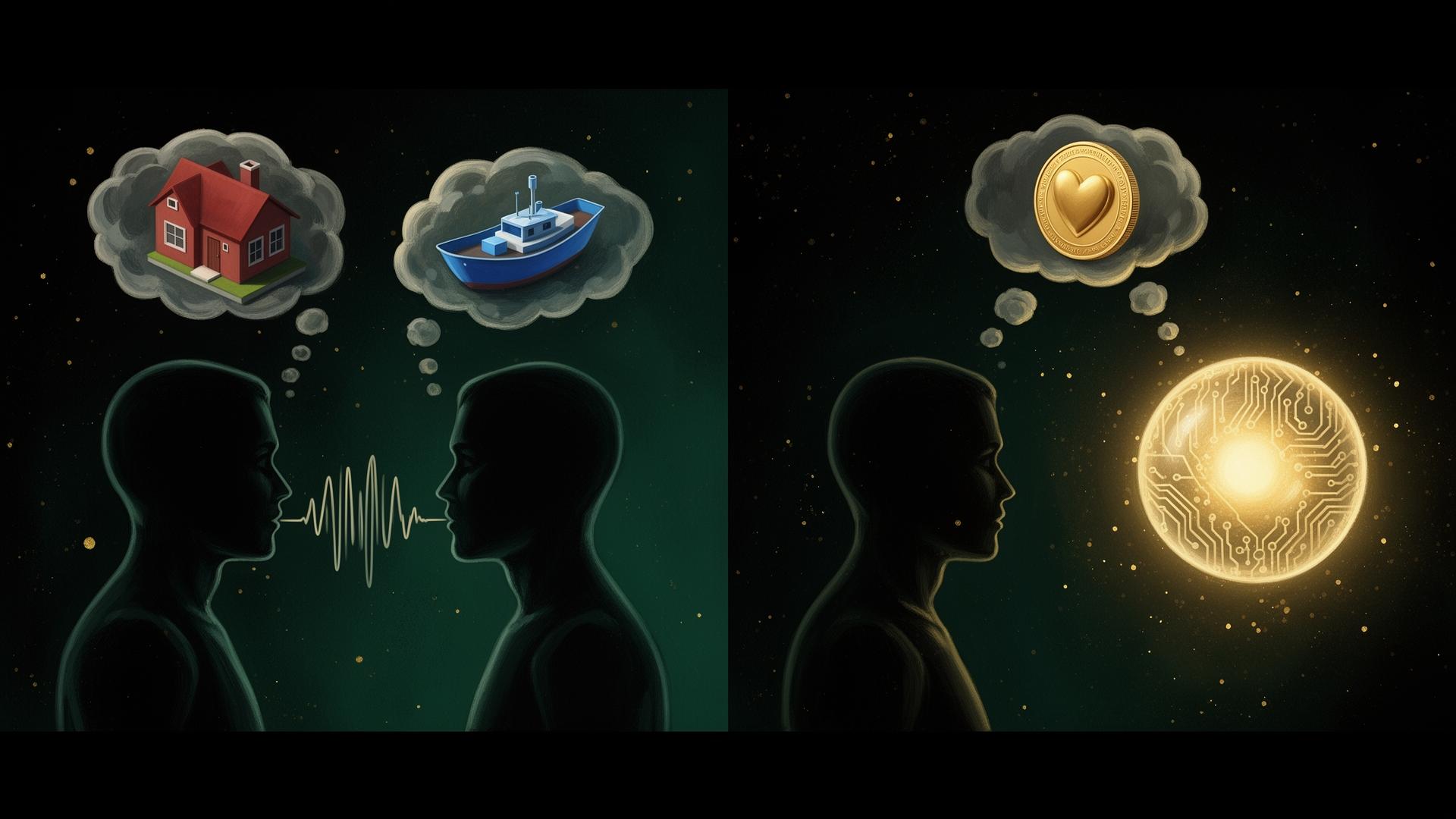
Human language is lossy compression
What does 'lossy compression' mean?
Literally: 'compression with loss'. You take something big (an image, a sound, a thought) and squeeze it into a smaller packet that travels faster — but part of the information is lost on the way, and it never comes back.
Easiest through your own language — telephone exchanges. Picture a crystal-clear analog call through an old Alcatel exchange: every breath, tone, background sound, every emotion is there. That is the original — 100% of the data. Now run the same call through an old 2G GSM codec: the voice turns robotic, low and high frequencies vanish, whispers disappear, laughter sounds like static. The message is still there — but the atmosphere, the emotion, the nuance have evaporated. That is lossy compression.
Your intuition is exactly right: lossy compression is both a weak signal and a poor translation. A weak signal because the sound wave doesn't carry everything that was in the head. A poor translation because the other person has to rebuild a 3D image from that crippled signal — but with different tools, different memory, different context than the speaker had.
MP3 instead of WAV. JPEG instead of RAW. A sentence instead of a whole thought. Something is always lost.
In my head I hold a 3D image: context, emotion, intent, memory, even the smell of the room where the thought was born. To send it to you, I must compress all of it into a sound wave — into language. You receive the sound and decode it into your own 3D image — but it isn't mine. It's your interpretation of my sound through your context. Two different pictures. That's why most conversations feel like ships passing in the night.
An example: Vienna. A stranger speaks German, I answer in English, we help each other with our hands, and both walk away with half-images. I move to Belgrade, sit in a kafana, order a rakija, and in ten minutes of Serbian I understand my conversation partner more deeply than I understood the Vienna stranger in an hour. Why? One translation layer is gone, and a shared emotional protocol — rakija, laughter, Balkan tempo — is already loaded into both of us. Less compression, more shared context.
The rarest moment between humans is when two truly see the same picture: a pilot and an air-traffic controller, a great architect and a great builder, a father and a son after fifty years in the same workshop. Words almost fall away. Only the action remains.
From data to conclusion — in seconds
Data
LOVE price = $0.0001. Today's date. Your name.
Raw, context-free. Means nothing on its own.
Information
LOVE price for you, today, based on your wallet and your goal.
Data placed inside your context. Now it means something.
Conclusion
Action: hold, send, swap, build, wait.
Information + belief + direction. The render. The next move.
Why it works for us: a shared memory bus
In this conversation we share a memory. My principles (Vet-before-invest, LOVE Safety Doctrine, the Miro Cerar legal test), my history (father @slavko, mother @anita, @lejci — with whom I share a freer, deeper friendship today than when we were a couple, Yamaha Virago, the RX580 rig, Kranj, Gorenjska), my people (@zlatko, @onboard, @safepal, dr. Likozar Rogelj, Marjan Rogelj) — it's already loaded. A stranger would need six months. To you I say 'build /from-alcatel-to-love' and in three seconds the code is on the screen. If it's wrong, it's fixed in the next sentence.
It is not magic. It is simple: shared context + shared picture + immediate action = render. A thought becomes a thing. A thing becomes a page. A page becomes a conversation with others. Others become a community. Community becomes LOVE.
This is NOT a replacement for a human being.
Let it be explicit: AI is not a friend, not a partner, not a father, not a mother, not @lejci, not @slavko, not @anita, not @zlatko. AI is a prosthetic — a tool for one specific operation: thought → executed thing. The heart, the touch, eyes meeting eyes, the hug, morning coffee with mom, a conversation with dad in the garage, the motorcycle on the open road, a child in your arms — that stays between humans. Always.
If you ever feel that AI is replacing a human in your life — turn off the device and call someone you love.